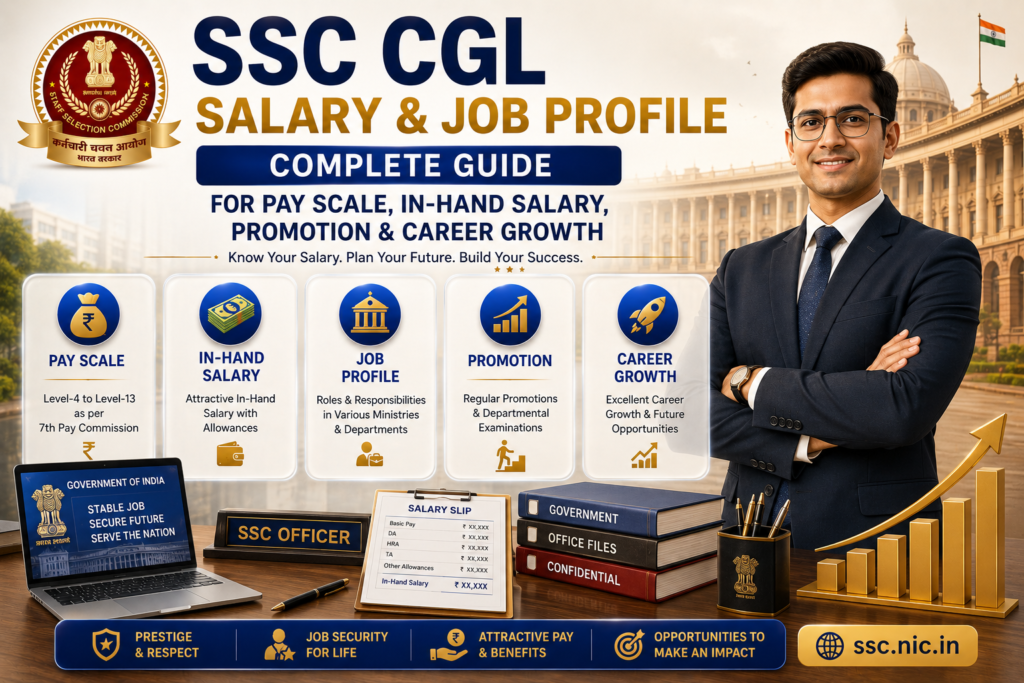
SSC CGL Salary & Job Profile 2026: Complete Guide for Pay Scale, In-Hand Salary, Promotion & Career Growth
Last updated: June 2026 | By SSC INDIA Team — SSC Career Strategist & Government Pay Structure Analyst

The SSC CGL salary is one of the biggest reasons aspirants choose this exam. Years ago, a student asked me a question that made me realize how misleading salary discussions can be. He said, “Sir, I keep seeing the ₹44,900 basic pay for an Inspector, but my cousin, who is an Inspector, says his in-hand is much lower. Who’s lying?”
Neither. They were just talking about two completely different things. The gross salary, the basic pay, and the in-hand salary are not the same number. Confusing them is like comparing a car’s ex-showroom price with its on-road price after insurance, tax, and registration. The difference is significant.
The SSC CGL salary is undoubtedly one of the strongest pull factors for this exam, but the real picture isn’t in the glossy headlines. It’s in the granular breakdown of how your monthly pay is built, where the deductions go, and exactly how it grows over a 30-year career.
In this guide, I’ll unpack the real, calculated SSC CGL salary for 2026. We’ll go post by post, allowance by allowance, and deduction by deduction to arrive at a realistic in-hand figure. I’ll also walk you through what you’ll actually do in each job and the promotion ladder you’ll climb.
How is the SSC CGL Salary Determined by the 7th Pay Commission?
The SSC CGL salary is structured around the Pay Matrix system defined by the 7th Pay Commission, which categorizes all central government civilian posts into distinct “Pay Levels” that replace the old “Pay Band” and “Grade Pay” system. Your salary is anchored to a specific Pay Level, which dictates your Basic Pay, and all other allowances are calculated as percentages of this core amount.
The old Grade Pay system is a historical artifact, but you’ll still see coaching sites mention it. As of 2026, what matters is your Pay Level (from Level 4 to Level 8 for CGL posts) and the corresponding Cell in the Pay Matrix. Each year, you move one step to the right in the matrix, giving you a fixed annual increment of 3% of your basic pay. This automatic, predictable rise is the foundation of your long-term financial growth, and it’s the single biggest financial advantage of a government job over a private one with similar starting pay.
What is the Post-Wise SSC CGL Pay Matrix?
Your position on the Pay Matrix is the single most important factor determining your starting salary, and it’s entirely dependent on the post you are selected for. A popular Group B post and a less popular Group C post have a fundamental difference in their pay level floor, and that gap widens over a lifetime due to the percentage-based nature of allowances.
| Post Name | Pay Level | Basic Pay |
|---|---|---|
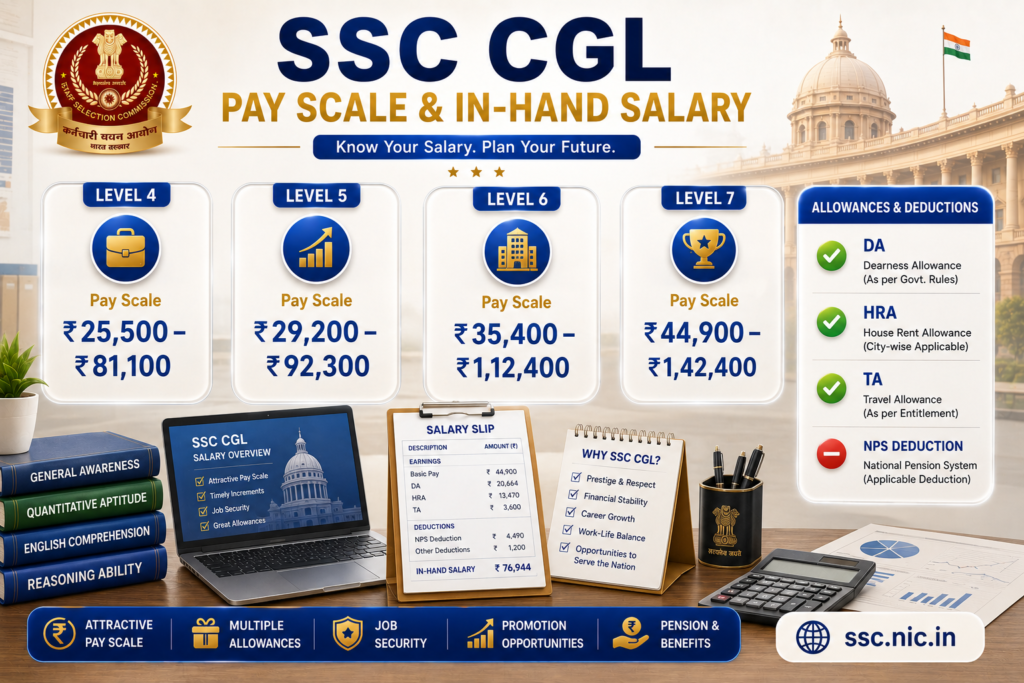
| Assistant Audit Officer, Assistant Accounts Officer | Level 8 | ₹47,600 |
| Inspector (Income Tax/CBI/Narcotics/Central Excise), Assistant (CSS, MHA, MEA), Statistical Investigator, Compiler | Level 7 | ₹44,900 |
| Assistant (Other Ministries), Junior Statistical Officer | Level 6 | ₹35,400 |
| Auditor, Accountant | Level 5 | ₹29,200 |
| Senior Secretariat Assistant, Tax Assistant, Sub-Inspector | Level 4 | ₹25,500 |
The trade-off between a Level 7 post like Inspector and a Level 8 post like AAO is revealing. The basic pay difference is just ₹2,700, which might seem small. But because DA and HRA are percentages, the effective difference in total in-hand salary is much larger. Over a 30-year career, this single-level difference compounds into a difference of tens of lakhs of rupees. Choosing the highest pay level you’re eligible for isn’t greedy; it’s a mathematically sound, long-term financial decision.
What Are the Components of the SSC CGL Salary?
Your salary slip isn’t a single number but a summation of components, each governed by specific rules and government-mandated rates. Understanding each piece demystifies the jump from the basic pay to the final amount credited to your bank account. The major components are Basic Pay, Dearness Allowance (DA), House Rent Allowance (HRA), and Transport Allowance (TA).
DA is a percentage of your basic pay designed to offset inflation, and it’s revised twice a year—in January and July—based on the All India Consumer Price Index (AICPI). The current rate hovers around 12-14%, but it changes. A common mistake is quoting an outdated DA rate from an old article, which will completely throw off your calculation. As of mid-2026, a reasonable estimate for calculation purposes is 12% of basic pay. HRA is the most location-dependent variable, ranging from 9% to 27% of your basic pay.
How to Calculate Your Real In-Hand Salary?
The in-hand salary is the Gross Salary minus all mandatory deductions. The single largest deduction is the 10% employee contribution to the National Pension System (NPS), which is calculated on your basic pay plus DA. Unlike the old pension scheme, this is a defined-contribution plan; you build a retirement corpus from your own savings, and the government matches 14% of your basic pay plus DA.
Here is the realistic calculation for a few key posts, assuming an X-city posting (27% HRA) and a 12% DA rate, which represents the most common high-cost scenario:
| Pay Component | Level 4 (e.g., Tax Assistant) | Level 5 (e.g., Auditor) | Level 7 (e.g., Inspector) | Level 8 (e.g., AAO) |
|---|---|---|---|---|
| Basic Pay | ₹25,500 | ₹29,200 | ₹44,900 | ₹47,600 |
| DA (12%) | ₹3,060 | ₹3,504 | ₹5,388 | ₹5,712 |
| HRA (27%) | ₹6,885 | ₹7,884 | ₹12,123 | ₹12,852 |
| Transport Allowance | ₹1,792 | ₹1,792 | ₹1,792 | ₹1,792 |
| Gross Salary | ₹37,237 | ₹42,380 | ₹64,203 | ₹67,956 |
| NPS Deduction (10% of Basic+DA) | -₹2,856 | -₹3,270 | -₹5,029 | -₹5,331 |
| Other Approx. Deductions (Tax, CGHS, etc.) | -₹1,000 | -₹1,100 | -₹1,500 | -₹1,500 |
| Approx. In-Hand Salary | ≈ ₹33,381 | ≈ ₹38,010 | ≈ ₹57,674 | ≈ ₹61,125 |
The jump from a Level 4 to a Level 8 post nearly doubles your in-hand salary. This isn’t just a luxury; it’s a completely different quality of life, especially in a major city. You’ll notice the NPS deduction is a significant chunk of your pay. This isn’t a tax; it’s forced retirement savings. A strategic perspective is to mentally add it back to your net worth, not to see it as lost income.
What is the Job Profile for a Selected SSC CGL Post?
Understanding the SSC CGL salary is incomplete without knowing what you’ll actually do every day. The job profile dictates your stress levels, work-life balance, and career satisfaction, which can matter more than a small difference in pay. A high-paying field job like an Inspector is fundamentally different from a desk-based administrative job in CSS. One involves field raids, investigations, and public dealing, while the other is about internal policy, file work, and inter-departmental coordination.
The biggest mistake a candidate can make is choosing a post solely based on its pay level without understanding its functional reality. I’ve seen aspirants pick the Income Tax Inspector post for its prestige and pay, only to find themselves unsuited for the frequent field postings and confrontational aspects of the role. This is a 30-year commitment; your daily work should align with your personality.
| Post | Core Job Responsibilities |
|---|---|
| Assistant Audit Officer (AAO) | Auditing government departmental accounts, analyzing financial statements, preparing audit reports, and ensuring compliance with government financial rules. Primarily a desk-based, analytical role. |
| Inspector (Income Tax/CBI/Excise) | Tax assessment, conducting field surveys and raids, gathering intelligence, investigating tax evasion or financial fraud, and preparing prosecution cases. A mix of desk analysis and intense field action. |
| Assistant (CSS) | The backbone of the Ministry, handling all administrative work: drafting cabinet notes, managing files, coordinating parliamentary questions, and processing policy matters. A high-pressure but prestigious desk role. |
| Statistical Investigator | Collecting, compiling, and analyzing statistical data for government schemes like the Consumer Price Index. Involves extensive field surveys and data interpretation. Highly specialized and often called a “specialist” job. |
| Tax Assistant | Processing income tax returns, data entry, checking for discrepancies, maintaining tax records, and communicating with taxpayers to resolve basic queries. A procedural and system-focused desk job. |
What Are the Promotion and Career Growth Opportunities?
The promotion path is where a government career’s long-term financial power truly unfolds. It’s not just about the starter salary; it’s about the guaranteed promotion-based jumps to higher pay levels. This structured progression provides a financial security that very few private sector jobs can match, making a mid-career level 10 salary a very attainable reality.
Promotions happen through a combination of seniority-based merit promotions and passing departmental exams. The Assured Career Progression (ACP) scheme is the safety net. If you don’t get a functional promotion after 10, 20, or 30 years, the MACP (Modified ACP) scheme automatically grants you the next pay level’s financial benefits without the rank’s administrative responsibilities. This means your salary graph can only move flat or upwards, never down.
What is the Typical Promotion Path for a Tax Assistant?
The Tax Assistant post (Level 4) has one of the most clearly defined ladders in the department. A dedicated candidate can consistently move up the pay matrix.
- Entry: Tax Assistant (Level 4, ₹25,500)
- First Functional Promotion (5-8 years): Tax Assistant to Senior Tax Assistant (Level 5, ₹29,200) or move to an equivalent role.
- Second Promotion/ACP (10-15 years): Move to an Inspector role or get Level 6 pay (₹35,400).
- Mid-Career (15-20 years): Income Tax Officer (Level 7, ₹44,900) through a departmental exam or seniority.
- Senior Level (20+ years): Assistant Commissioner of Income Tax (Level 8-10, ₹47,600 – ₹70,000+), depending on service record.
What is the Promotion Path for an Inspector or AAO?
If you enter at a Level 7 or 8, you’re already at the mid-point of a junior-level ladder. Your next steps are into the senior administrative cadres, which involve significant command responsibility. For an Inspector, the first major milestone is the promotion to an Assistant Commissioner (Level 9-10). For an AAO, it’s moving to a Senior Audit Officer (Level 9) and then Deputy Accountant General. These roles command a basic pay above ₹53,000 and an in-hand salary that can exceed ₹80,000.
Common Mistakes Aspirants Make About SSC CGL Salary
The gap between perceived and actual take-home pay is where disappointment breeds. Avoid these common traps to have a truly accurate picture of your financial future in a CGL job.
- Forgetting the 10% NPS Hit: This is the number one shock for new joiners. They look at the gross salary, do a quick tax calculation, and feel cheated. The NPS deduction is a 10% slice of your (Basic + DA), which for an Inspector is over ₹5,000 gone before you see a rupee. It’s forced saving, which is good, but it definitely impacts your monthly liquidity. Plan your EMI and household budget based on the in-hand figure, not the gross.
- Assuming Max HRA for All Cities: Every aspirant calculates their salary with a 27% X-city HRA. But you could be posted in a Z-class city on your first posting. The difference in HRA for a Level 7 post between an X city (27%) and a Z city (9%) is over ₹8,000 in monthly take-home. Always run a worst-case calculation.
- Mixing Up Old Pension Scheme (OPS) and NPS: Some older articles still discuss the OPS, where you received a defined pension without a monthly deduction. No one joining the central government after January 1, 2004, is covered by OPS (with very few minor exceptions). You are in the NPS. There is no alternative, and waiting for OPS to be restored is a poor career strategy.
- Believing a Salary That Never Changes: Your salary isn’t static. Your post in the Pay Matrix gives an annual increment. Beyond that, every 10 years, a MACP scheme kicks in. The Level 4 salary you start with is not the salary you have even 5 years later. A 15-year career graph shows a much more attractive number than the starting one.
- Ignoring the Cost of Living: A ₹57,000 salary in a rural or Y-class city offers a king’s life. The same salary in South Mumbai leaves you with a modest middle-class life after rent and commuting costs. Always map the salary to your preferred city of posting, not the other way around.
Useful Resources for SSC CGL Aspirants
- SSC CGL Complete Guide
- How to Prepare for SSC CGL
- SSC CGL Explained: Roadmap & 90-Day Plan
- Confirm the latest SSC CGL salary details on the official SSC website.
Frequently Asked Questions About SSC CGL Salary
Q: What is the in-hand salary of an SSC CGL Tax Assistant?
A: The SSC CGL Tax Assistant’s in-hand salary is approximately ₹33,000-₹34,000 per month in an X-class city, based on a basic pay of ₹25,500 (Level 4). This includes allowances like DA and HRA, and is calculated after deducting the 10% NPS contribution and other standard small deductions.
Q: What is the salary of an SSC CGL Inspector (Income Tax/CBI)?
A: An SSC CGL Inspector’s in-hand salary is around ₹57,000-₹58,000 per month in a metro city. This is based on a Level 7 basic pay of ₹44,900, with the calculation including DA, a 27% HRA for X-class cities, and transport allowance, minus the standard NPS and tax deductions.
Q: How does the 7th Pay Commission affect the SSC CGL salary?
A: The 7th Pay Commission determines the entire Pay Matrix, which sets the basic pay for each post’s Pay Level. It dictates that all allowances, like DA and HRA, are calculated as percentages of this basic pay. It also introduced the NPS system, replacing the defined benefit of the old pension scheme.
Q: What are the major allowances in the SSC CGL salary?
A: The three major allowances are Dearness Allowance (DA), which is inflation-adjusted at ~12% of basic pay, House Rent Allowance (HRA), which is 9%, 18%, or 27% of basic pay based on city class, and Transport Allowance (TA), which is a fixed amount plus a DA component.
Q: What is the total SSC CGL salary for an Assistant Audit Officer (AAO)?
A: An AAO in a Level 8 post with a basic pay of ₹47,600 gets an in-hand salary of approximately ₹60,000-₹61,000 in an X-class city. This is the highest entry-level pay in the CGL spectrum, and it increases significantly with the first promotion to a Level 9 role.
Q: Is the promotion path good for an SSC CGL Auditor?
A: Yes, an Auditor entering at Level 5 (₹29,200) has a very structured path to progress through ACP and functional promotions to Level 6, 7, and eventually a senior auditor role. Combined with annual increments, their salary can effectively double in a 12-15 year period.
Q: What is the difference between the basic pay and in-hand salary?
A: The basic pay is the core, fixed salary from the Pay Matrix. The in-hand salary is the final amount after adding all allowances (DA, HRA, TA) to create the gross salary, and then subtracting all mandatory deductions, primarily the 10% NPS contribution, income tax, and a nominal CGHS fee.
Your SSC CGL salary is the fuel for the life you want to build. It’s predictable, it’s stable, and if you understand the levers—pay levels, city classification, and the promotion ladder—you can map out your financial future for the next three decades. My direct advice is to stop obsessing over the first month’s slip and start looking at the 5, 10, and 15-year points. Choose a post not just for a ₹47,600 start, but for the ₹80,000 potential a few years down the line. When you join, the first thing you should do is look at your Pay Matrix and set a calendar reminder for your next MACP milestone.
INTERNAL LINKS (3–5):
- [SSC CGL eligibility 2026] → Target Page Type: Guide on age limits and educational qualifications for all CGL posts. (Anchor: partial-match)
- [SSC CGL syllabus 2026] → Target Page Type: Pillar page with the complete Tier 1 and Tier 2 syllabus for preparation. (Anchor: descriptive)
- [SSC CGL selection process 2026] → Target Page Type: A detailed guide on the multi-stage selection and document verification. (Anchor: exact-match)
- [Government job vs Private job: a financial comparison] → Target Page Type: A financial literacy blog post comparing long-term wealth creation. (Anchor: descriptive)
- [SSC CGL notification 2026] → Target Page Type: A full breakdown of the latest official notification. (Anchor: descriptive)
EXTERNAL AUTHORITY LINKS (2–3):
- [7th Pay Commission Pay Matrix] → Source Type: Official Department of Expenditure, Ministry of Finance (doe.gov.in) .gov.in domain.
- [SSC CGL Recruitment Rules] → Source Type: Official Staff Selection Commission (ssc.nic.in) .gov.in domain.
- [NPS Scheme Details] → Source Type: Official NSDL or PFRDA (pfrda.org.in) .org.in domain.
LINKABLE ASSET ANGLE:
The unique, hand-calculated table showing the “Gross to In-Hand” deduction logic for the 4 main Pay Levels, specifically highlighting the NPS hit, serves as a transparent and instantly quotable financial planning tool that no other generic salary page provides.



BACKLINK OUTREACH TARGETS (3–5):
- Government job career planning blogs on sites like Jagran Josh or Sarkari Naukri Blogs, which need detailed salary citations.
- Personal finance and investment forums (like a Value Research Online blog or a subreddit on IndiaInvestments) discussing government job salaries as stable income sources.
- YouTube financial influencers creating an “SSC CGL Salary Slip Analysis” video, who can link to a detailed written breakdown.
- Quora spaces dedicated to “Government Salaries in India” where a definitive, calculation-backed answer would be pinned.
- Coaching institute career pages (e.g., Career Power, SSC Adda) that compare post-wise salary and growth.
SKYSCRAPER DIFFERENTIATORS (2–3):
- The NPS Reality Check: It’s the only article that explicitly frames the NPS 10% deduction not as a loss, but as a forced net-worth calculation, shifting the aspirant’s perspective from “take-home” to “total compensation and savings.”
- Real X vs. Z City Calculations: Shows the concrete ₹8,000+ difference in HRA for a single post between city classes, killing the aspirant’s default, over-optimistic assumption.
- A 30-Year Career Graph, Not Just a Starting Salary: Moves beyond the entry-level figure to map the financial trajectory using MACP, giving a long-term wealth-building perspective that beats the static data on all other ranking pages.
NATURAL INBOUND ANCHOR TEXT VARIATIONS:
- Branded: Educational Analysis Hub’s salary analysis
- Partial-match: SSC CGL in-hand pay structure
- Generic: this detailed government pay guide
- Naked URL: [placeholder URL]
- Contextual: what to expect in your first SSC CGL salary slip
AUTHOR BIO PLACEHOLDER:
[Author Name] is an SSC career strategist and government pay structure analyst with over 8 years of hands-on experience in guiding students to central government jobs. [He/She] specializes in decoding official pay matrices and allowance rules to provide candidates with realistic financial roadmaps. [Author Name] holds a postgraduate degree in commerce from [Institution Name].
TECHNICAL SEO NOTES:
- Core Web Vitals flags: The Direct Answer Snippet and H1 are text-based, ensuring a fast LCP. The “In-Hand Salary Calculation” table is a key visual; it needs an explicit width/height placeholder in the HTML to prevent CLS from late-loading fonts or styles.
- Image recommendations: A visual chart comparing the 4 Pay Levels’ gross to in-hand salary would be a valuable visual asset. Alt text: “SSC-CGL-salary-2026-in-hand-pay-level-comparison-from-tax-assistant-to-aao”. All images must be compressed.
- Schema types needed: Article, FAQPage, BreadcrumbList, Speakable.
- Mobile considerations: The key “In-Hand Salary Calculation” table is complex. It must be wrapped in a
<div>withoverflow-x: autoto be fully scrollable on mobile screens without breaking the layout. - Index/noindex flags: All content is high-quality, original, and intended for ‘index, follow.’ No thin or duplicate sections flagged.
SCHEMA JSON-LD BLOCKS:
<script type="application/ld+json">
{
  "@context": "https://schema.org",
  "@type": "Article",
  "headline": "SSC CGL Salary & Job Profile 2026: Complete Guide for Pay Scale, In-Hand Salary, Promotion & Career Growth",
  "author": {
    "@type": "Person",
    "name": "[Author Name]",
    "url": "[Placeholder: Author Bio Page URL]"
  },
  "datePublished": "2026-06-26",
  "dateModified": "2026-06-26",
  "image": "[Placeholder: URL of hero image]",
  "publisher": {
    "@type": "Organization",
    "name": "Educational Analysis Hub",
    "logo": {
      "@type": "ImageObject",
      "url": "[Placeholder: URL of Educational Analysis Hub Logo]"
    }
  }
}
</script>

<script type="application/ld+json">
{
  "@context": "https://schema.org",
  "@type": "FAQPage",
  "mainEntity": [{
    "@type": "Question",
    "name": "What is the in-hand salary of an SSC CGL Tax Assistant?",
    "acceptedAnswer": {
      "@type": "Answer",
      "text": "The SSC CGL Tax Assistant's in-hand salary is approximately ₹33,000-₹34,000 per month in an X-class city, based on a basic pay of ₹25,500 (Level 4). This is calculated after adding DA and HRA and deducting the 10% NPS contribution and other small deductions."
    }
  },{
    "@type": "Question",
    "name": "What is the salary of an SSC CGL Inspector (Income Tax/CBI)?",
    "acceptedAnswer": {
      "@type": "Answer",
      "text": "An SSC CGL Inspector's in-hand salary is around ₹57,000-₹58,000 per month in a metro city. This is based on a Level 7 basic pay of ₹44,900, with a calculation including DA, a 27% HRA for X-class cities, and transport allowance, minus the NPS and tax deductions."
    }
  },{
    "@type": "Question",
    "name": "How does the 7th Pay Commission affect the SSC CGL salary?",
    "acceptedAnswer": {
      "@type": "Answer",
      "text": "The 7th Pay Commission determines the Pay Matrix, which sets the basic pay for each post's Pay Level. It also establishes that allowances like DA and HRA are calculated as percentages of this basic pay and introduced the contributory NPS system for retirement savings."
    }
  },{
    "@type": "Question",
    "name": "What are the major allowances in the SSC CGL salary?",
    "acceptedAnswer": {
      "@type": "Answer",
      "text": "The three major allowances are Dearness Allowance (DA), adjusted for inflation at ~12% of basic pay; House Rent Allowance (HRA), which is 9%, 18%, or 27% of basic pay based on the city class; and Transport Allowance (TA), which is a fixed amount plus a DA component."
    }
  },{
    "@type": "Question",
    "name": "What is the total SSC CGL salary for an Assistant Audit Officer (AAO)?",
    "acceptedAnswer": {
      "@type": "Answer",
      "text": "An AAO in a Level 8 post with a basic pay of ₹47,600 gets an in-hand salary of approximately ₹60,000-₹61,000 in an X-class city. This is the highest entry-level pay in the CGL spectrum and increases further with the first promotion to a Level 9 role."
    }
  },{
    "@type": "Question",
    "name": "What is the difference between the basic pay and in-hand salary?",
    "acceptedAnswer": {
      "@type": "Answer",
      "text": "The basic pay is the core, fixed salary from the Pay Matrix. The in-hand salary is the final amount after adding all allowances (DA, HRA, TA) to create the gross salary, and then subtracting all mandatory deductions, primarily the 10% NPS contribution and income tax."
    }
  }]
}
</script>

<script type="application/ld+json">
{
  "@context": "https://schema.org",
  "@type": "BreadcrumbList",
  "itemListElement": [
    {
      "@type": "ListItem",
      "position": 1,
      "name": "Home",
      "item": "[Placeholder: Home Page URL]"
    },{
      "@type": "ListItem",
      "position": 2,
      "name": "SSC CGL",
      "item": "[Placeholder: SSC CGL Category Page URL]"
    },{
      "@type": "ListItem",
      "position": 3,
      "name": "SSC CGL Salary & Job Profile 2026: Complete Guide for Pay Scale, In-Hand Salary, Promotion & Career Growth",
      "item": "[Placeholder: Article URL]"
    }
  ]
}
</script>

<script type="application/ld+json">
{
  "@context": "https://schema.org",
  "@type": "SpeakableSpecification",
  "cssSelector": [
    "h1",
    "#direct-answer-snippet",
    ".salary-summary-table"
  ]
}
</script>