To prepare for the How to Prepare for SSC CGL Strategy, Books & Plan, you must reverse-engineer the syllabus into a 6-month plan that prioritizes high-weightage topics first. Start by mastering the fundamentals of Quantitative Aptitude and Reasoning for two months, then shift to intensive practice and speed-building for the next two, and finally, dedicate the last two months exclusively to full-length mock tests, rigorous error analysis, and revision. Use only one standard book per subject, practice 50-80 questions daily, and take a minimum of 30 mock tests before the Tier 1 exam.

How to Prepare for SSC CGL | Complete Strategy, Books, Study Plan & Timetable
Most SSC CGL study plans are fiction. They assume you’ll wake up at 5 AM every day, study for 8 focused hours, and never have a bad day, a family function, or a moment of crippling self-doubt. Then, when you miss a day, you feel like you’ve failed the entire plan, and you quit.
I’ve seen this cycle destroy promising candidates more than any difficult math topic ever has.
The truth is, a preparation strategy that doesn’t account for your humanity is useless. What you need isn’t a rigid jail sentence. It’s a flexible, phased system that tells you exactly what to do when you sit down to study, whether you have 6 hours that day or just 2.
This is the exact preparation framework I’ve used to mentor students for the last 8 years. It’s built on one core principle: consistency over intensity, every single time. I’ll give you a 6-month phase-wise plan, a subject-by-subject tactical breakdown, a list of the only books you actually need, and a mock test strategy that forces you to improve, not just perform.
Phase 1: The Foundation (Months 1 & 2) — Stop Skipping This
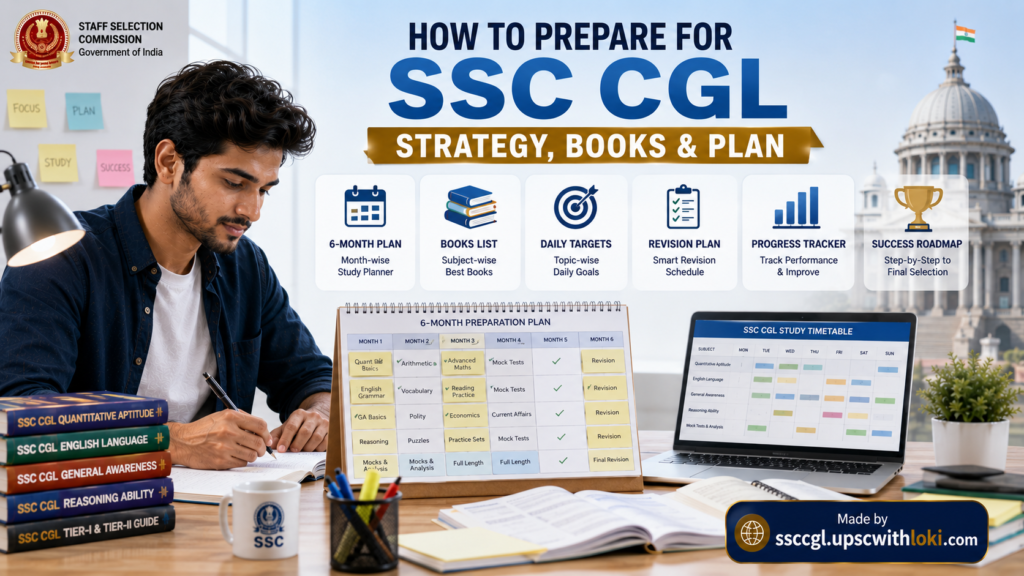
The first two months are not about solving advanced-level puzzles or memorizing the entire GDP history. They’re about building a base in the two subjects that will determine your score more than any other: Quantitative Aptitude and Reasoning. If your arithmetic is slow, you are dead in the water before the race even begins.
Your goal here is not speed. It’s conceptual clarity. If you can’t explain a Profit and Loss problem to a friend without looking at the formula, you haven’t learned it.
- Quantitative Aptitude: Do not start with Algebra or Geometry. Start with the arithmetic spine: Number System, Simplification, Percentage, Ratio & Proportion, and Average. These five topics are the silent foundation of 60% of the Math paper. Spend a full week just on Percentage. If you truly master Percentage, Profit & Loss and Simple/Compound Interest become natural extensions, not separate chapters to memorize.
- Reasoning: Start with the high-scoring, low-effort blocks: Analogy, Classification, and Series. These train your brain to see patterns without the cognitive load of a multi-variable puzzle. Then, and only then, move to Coding-Decoding and Blood Relations. Leave complex seating arrangements and floor puzzles for Phase 2.
- English: You cannot “cram” English in a weekend. Your daily tasks are small: read one editorial from The Hindu or Indian Express aloud. Not silently—aloud. This improves your grammar intuition, your vocabulary, and your reading speed for the comprehension section simultaneously. For grammar, drill the basics of Subject-Verb Agreement and Tense rules into your head. They are non-negotiable.
- General Awareness: Do not open a Lucent book and start reading from page one. You’ll fall asleep by page 15. Instead, use the “Pirate Method.” Start with the last 6 months of Current Affairs, and when a news item references a historical event or a constitutional article, then go back and study that specific static topic. News about a border dispute? That’s your cue to study that specific geography chapter. This method ties static facts to a memorable context.
Phase 2: The Scaling Phase (Months 3 & 4) — The Grind
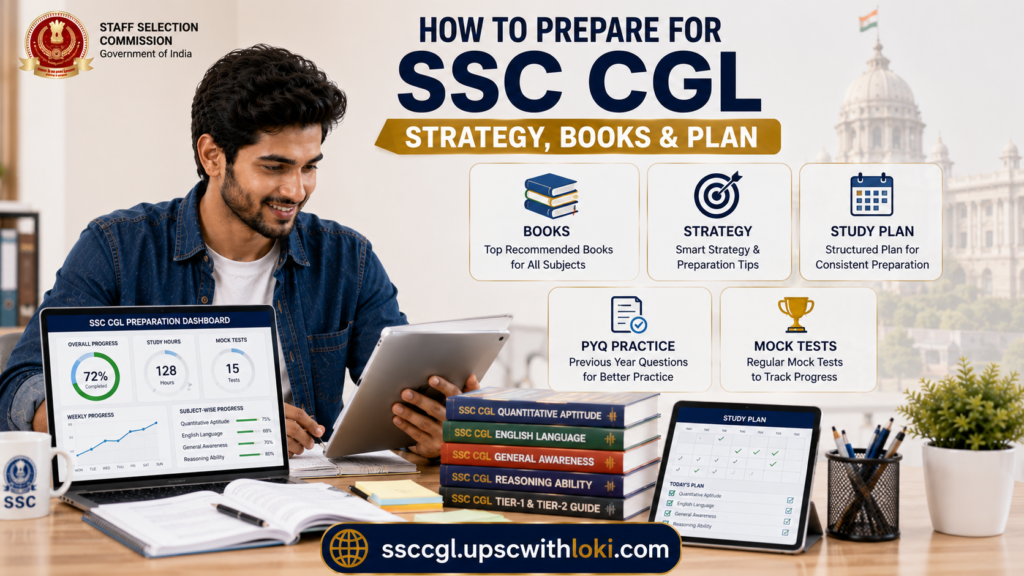
This is where most people break. The novelty is gone, and the easy gains are behind you. Now, you move from understanding concepts to applying them under brutal time pressure. You start solving 50-80 questions a day, not 20-30.
This is the phase where you attack the “scary” math topics—Algebra, Trigonometry, and Mensuration. Instead of solving them randomly, learn to recognize the 4-5 fixed question types the SSC asks from each. The SSC loves specific types of algebraic identity questions and specific circle tangent theorems. Your job is to spot the pattern in the previous year’s questions so that you know what formula to apply within the first 5 seconds of reading the question.
For Reasoning, this is your puzzle phase. Block out 45 minutes daily for nothing but puzzles. Sitting arrangement, floor-based, and box-based puzzles must be drilled until they become boring. A common mistake is to avoid the hard puzzles in practice and hope you get an easy one in the exam. Hope is not a strategy. In English, move from the “spot the error” to the “select the correct phrase” questions, which are trickier. Your vocabulary work doubles: add 15 new words daily, but learn them in pairs—a word and its exact opposite or its closest contextual synonym.
Phase 3: The War Room (Months 5 & 6) — Mocks & Ruthless Analysis
The last 60 days are for one thing: full-length, exam-condition mock tests. Not topic tests, not sectional tests—full 60-minute Tier 1 simulations. Your daily schedule is now built around a 3-day cycle: Mock Test Day, Analysis Day, and Weakness Repair Day.
Taking a mock test and just glancing at your score is worse than not taking it at all. It builds a false confidence in a score that means nothing. Proper analysis takes as long as the test itself.
How to Analyze a Mock Test Properly
- Calculate Your “True Score”: Subtract the marks you earned from lucky guesses. These are landmines that will explode in the real exam.
- The “Low-Hanging Fruit” Scan: Look for the questions you got wrong where you almost knew the answer—a formula you forgot, a calculation error, a word you’d seen but couldn’t recall. These are the cheapest, fastest marks you can add to your score. Fix these first.
- The “Time Sink” Audit: Identify two questions that you stubbornly spent 3-4 minutes on and still got wrong. These are the questions that killed your chance at 3 other easy ones. The next time you see a question like that, you skip it without mercy. Learning what not to solve is an elite-level skill.
A practical mock test schedule: 2 tests per week in Month 5, and 3-4 tests per week in Month 6. Do the math: by the time you walk into the real exam, you should have written at least 25-30 full-length Tier 1 mocks. This builds a psychological callus against exam fear.
The Daily Timetable That Survives Real Life
A rigid hourly schedule is a lie. Instead, use a block-based system. A block is an uninterrupted 90-minute session. You need 3-4 blocks a day, not a color-coded 16-hour plan.
| Time Block | Focus Block | Non-Negotiable Activity |
|---|---|---|
| Morning Block (e.g., 7:00 AM – 8:30 AM) | Power Subject | Your weakest subject. For most, this is Quantitative Aptitude. No phone, no notifications. Deep calculation work. |
| Mid-Day Block (e.g., 12:00 PM – 1:30 PM) | Active Recall | Reasoning or English practice. Not learning new concepts; solving questions from previously studied topics to solidify the neural pathway. |
| Evening Block (e.g., 5:00 PM – 6:30 PM) | Absorption | General Awareness. Watch a video, read a news compilation PDF, and connect static facts. This is a lower-cognitive-load block. |
| Night Block (e.g., 9:30 PM – 10:00 PM) | Lock-In | 30 minutes of rapid-fire revision of the day’s formulas and vocabulary. No new material. This is the retention glue. |
The weekend is for a full mock test and its analysis. Saturday is the test. Sunday is the repair work. You don’t need to study 12 hours a day. You need 3 high-quality, interruption-free blocks and one 30-minute revision. Do this for 180 days, and the exam will feel like just another mock test.
The Only Books You Need (Don’t Build a Library)

The biggest preparation mistake is creating a shelf full of unopened books. You need exactly one primary book per subject and a secondary source for deep practice. That’s it.
- Quantitative Aptitude: Start with Quantitative Aptitude by R.S. Aggarwal to learn the fundamental concepts. Then, move to Quick Arithmetic by Ashish Aggarwal or the Rakesh Yadav Class Notes for the advanced, exam-specific shortcut tricks and the previous year question compilations. Don’t use all three at once; you’ll confuse methodologies.
- Reasoning: A New Approach to Reasoning by B.S. Sijwali & Indu Sijwali is the gold standard. It’s comprehensive and well-structured. For a supplementary deep-dive into analytical puzzles, M.K. Pandey’s Analytical Reasoning is excellent, but only if you’ve fully exhausted the first book.
- English: Objective General English by S.P. Bakshi is your rulebook and drill manual. To build a command of vocabulary that is a genuine strength, Word Power Made Easy by Norman Lewis is non-negotiable. It’s not a list of words; it’s a root-based system.
- General Awareness: Lucent’s General Knowledge is the most widely used reference for static facts. But reading it is passive. Your active tool is a monthly Current Affairs compendium from a reputable source like Vision IAS or a similar publication, which you must update and revise weekly.
Common Mistakes That Feel Like Progress
These feel productive but are actively sabotaging your score.
- The “Concept Tourist” Problem: You watch a 2-hour video on a math topic, take perfect notes, and feel like you’ve accomplished something. You haven’t. You’ve outsourced the thinking. You only learn when you close the book, take a blank sheet of paper, and solve 20 questions without peeking. The gap between watching someone solve a problem and doing it yourself in a timed test is a canyon.
- Precious Note Paralysis: You’re building a beautiful, multi-colored notebook of formulas. It’s a form of procrastination. A formula sheet should look like a messy cheat sheet by the end of your prep, not a museum piece. Its only purpose is to help you memorize and apply. Scribble on it, test yourself with it, and don’t treat it as a sacred text.
- The “I’ll Do It Later” GK Trap: You push GK to the end because it’s “just memorization.” Then, in Month 6, you panic-try to cram 12 months of current affairs and the entire history of India. GK is a daily drip. 45 minutes a day from Day 1 is the only way it works. Your Tier 1 qualifying status will likely depend on how well you handle this section, not on your math score.
Frequently Asked Questions About SSC CGL Preparation
Can I really crack the SSC CGL in just 3 months?
Yes, but it requires a brutal, honest assessment. A 3-month plan is not for a beginner learning from scratch. It’s for someone who already has a moderate grasp of arithmetic and reasoning. You will study 8-10 focused hours daily, skip all low-weightage topics, and take 4-5 mock tests per week from the very first week.
How is the preparation for Tier 2 different from Tier 1?
Tier 1 is a speed sprint. Tier 2 is a depth marathon. For Tier 2, you abandon the superficial tricks and prepare for a multi-layered, analytical exam. The math is much more conceptual, the reasoning involves complex, multi-variable puzzles, and there is no GK section, replaced by a deep English language module requiring advanced comprehension.
I’m working a full-time job. How many hours should I study?
You need 3-4 high-quality hours on weekdays and 8-10 hours on weekends. Use your morning block for the toughest subject before work drains your mental energy. Your commute is for vocabulary and current affairs. Your weekend is exclusively for a full-length mock test and its detailed analysis.
Which online test series is the best for SSC CGL?
There isn’t a single “best” one, as the quality changes yearly. A good test series gives you a percentile rank among other candidates, not just a score. Look for one with a large user base (like Testbook, Oliveboard, or adda247), detailed video solutions, and an interface identical to the actual SSC exam screen.
What should I do exactly one month before the SSC CGL Tier 1 exam?
Stop learning anything new. Your last 30 days are entirely for consolidation. Your cycle is a 2-day loop: take a full mock test on Day 1, and spend Day 2 doing nothing but analyzing that test and revising all the formulas, notes, and vocabulary from the topics you got wrong.
Your goal isn’t to study for 12 hours today. It’s to study for 3 focused hours today, and do it again tomorrow, and the day after that, for six months. That’s how you beat the person who is cramming 10 hours on a weekend and burning out by Tuesday. Buy your two core books, block your time, and start your first 50-question arithmetic set. The exam doesn’t reward who is the smartest. It rewards who is the most consistent. Be that person.