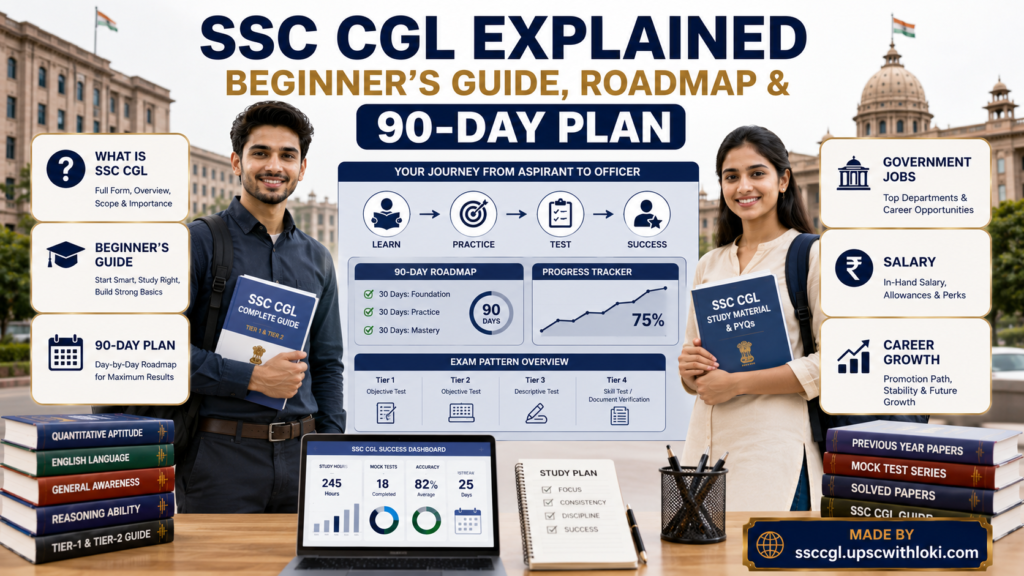
SSC CGL Explained: Complete Beginner’s Guide, Roadmap & 90-Day Preparation Plan
Most guides about the SSC CGL exam make a fundamental mistake: they assume you already know the basics. They throw around terms like “Tier 2,” “normalization,” and “Pay Level 7” as if you learned them in school. You didn’t. And when you’re a beginner, that jargon is a wall. It makes the whole thing feel impossibly complicated and pushes you away before you even start.
It’s not complicated. It’s just unfamiliar.
Let me explain the SSC CGL to you as if we’re sitting across a table. No prior knowledge needed. By the time you finish reading this, you won’t just know what the exam is—you’ll have a one-page cheat sheet, a clear roadmap, and a practical 90-day plan to get moving. Let’s cut through the noise.
SSC CGL in Simple Words: What It Actually Is
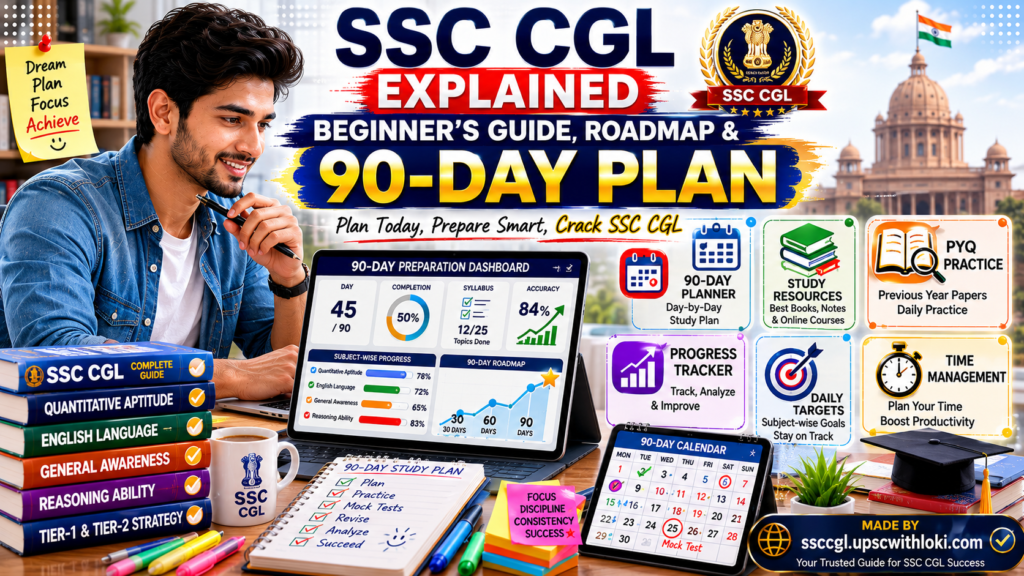
The simplest way to understand the SSC CGL is to see it as a centralized hiring exam. The Staff Selection Commission (SSC) is the government’s HR department for a huge chunk of its ministries. The Combined Graduate Level (CGL) exam is the specific test they designed for graduates. One exam. Many jobs. Your score decides which job you get offered.
Here’s the translation table for the terms that confuse everyone:
| Jargon Term | What It Actually Means |
|---|---|
| SSC | The government body that acts as the recruiter. |
| CGL | The level of the exam—it’s for people with a college degree (graduates). |
| Tier 1 | The first, easier screening test. It’s a speed round. |
| Tier 2 | The second, harder, and more important test. Your score here decides your job. |
| Group B / C Post | The category of the government job. Group B is an officer-level role. Group C is a clerical or assistant-level role. |
In one brutally honest sentence: the SSC CGL is your ticket to a secure, well-paying government officer job, but you have to outrank roughly 15-20 lakh other applicants to get the ticket punched.
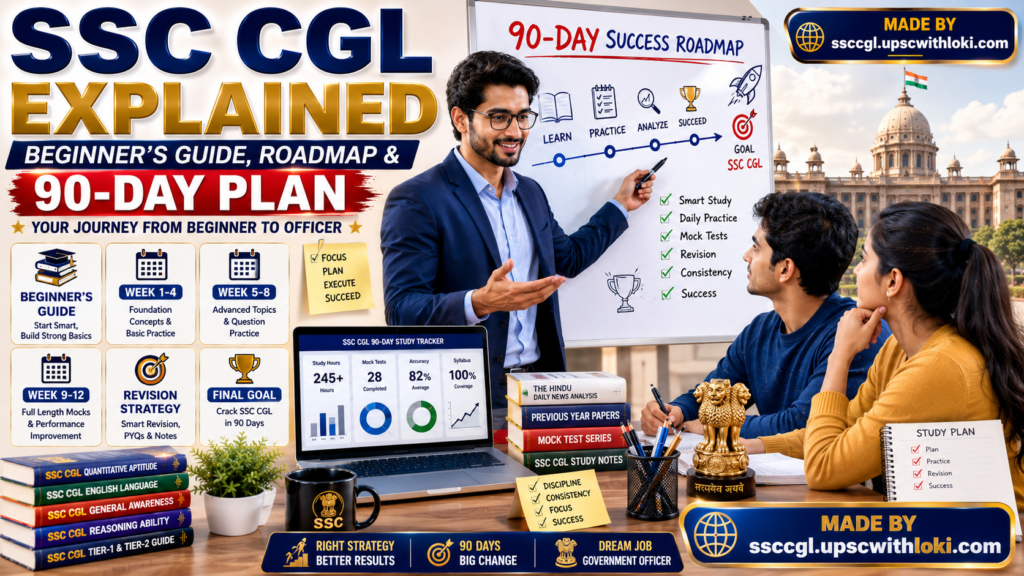
The SSC CGL One-Page Guide: Everything at a Glance
This is the page I’d give a friend to read in two minutes. It’s everything you need to know, stripped to the bone.
| Aspect | The Quick Answer |
|---|---|
| Full Form | Staff Selection Commission – Combined Graduate Level Examination |
| Who Can Apply? | Any Indian citizen with a Bachelor’s degree (any stream) from a recognized university. |
| Age Limit | 18-32 years for the General category. It’s lower for some posts, and there’s relaxation for OBC/SC/ST. |
| Number of Attempts | Unlimited. You can try every year until you cross the age limit for your category. |
| Tier 1 Exam | 100 questions (25 each from Reasoning, GK, Maths, English) in 60 minutes. Total 200 marks. |
| Tier 2 Exam | A longer, tougher exam with 3 papers. Paper 1 is compulsory for all. Papers 2 and 3 are for specialist posts only. |
| Application Fee | ₹100 for General/OBC men. Free for women, SC/ST, and PwD candidates. |
| Official Website | ssc.nic.in |
| Starting In-Hand Salary | ₹33,000 – ₹34,000 for a Tax Assistant. ₹57,000 – ₹58,000 for an Inspector. ₹60,000+ for an AAO. |
The Top 5 CGL Posts at a Glance
| Post | Salary (In-Hand) | Best For… |
|---|---|---|
| Assistant Audit Officer (AAO) | ₹60,000+ | Highest starting salary, analytical desk work. |
| Inspector (Income Tax/CBI) | ₹57,000+ | Authority, field action, and excellent career growth. |
| Assistant (CSS) | ₹57,000+ | Policy work, work-life balance, and prestige in Delhi. |
| Statistical Investigator | ₹57,000+ | Candidates who love data and have a Statistics background. |
| Tax Assistant | ₹33,000+ | An excellent, stable entry-level job to start a career. |
SSC CGL Quick Facts: The Numbers You Should Know
Here are the statistics that define the game. They aren’t meant to scare you; they’re meant to build the right strategy.
- 15-20 lakh applicants every year. You’re in a massive race. The only way to win is to be more strategic, not just more hardworking.
- 60 minutes for 100 questions in Tier 1. That’s exactly 36 seconds per question. This exam tests your speed and your cold-blooded ability to skip a tough question without hesitation.
- Negative marking is real. In Tier 1, a wrong answer costs you 0.50 marks. Guesswork is a losing strategy. Accuracy is your only currency.
- There is no interview. Your marks on the written exam are the sole basis for your selection and your rank on the final merit list. The process is purely objective.
- A 0.5-1% success rate. The only way to bridge the gap between 20 lakh applicants and 10,000 seats is to prepare for the exam that will be set, not the one you wish would be set.
Your Beginner Roadmap: A 6-Month, 3-Phase Plan
You don’t need a detailed day-by-day calendar. You need a mental model for the journey. The 6-month roadmap is divided into three distinct phases, and the biggest mistake beginners make is trying to do Phase 3 activities in Phase 1.
Phase 1: Foundation (Months 1-2) — The “Aha” Phase
Your only goal here is to go from “I don’t know this” to “I understand this.”
- Maths: Focus entirely on the arithmetic spine—Percentage, Ratio, Average, Profit & Loss. Do not touch Algebra or Geometry yet.
- Reasoning: Start with the verbal basics—Analogy, Classification, Series, Coding-Decoding. These build your pattern-recognition muscle.
- English: You must fall in love with reading. Read one editorial aloud daily. Drill the basics of Tenses and Subject-Verb Agreement.
- GK: Don’t try to memorize everything. Spend 45 minutes a day on one static subject (like History), and 15 minutes on yesterday’s current affairs.
Phase 2: Practice (Months 3-4) — The Grind
This is where you convert understanding into application. You now solve 50-80 questions daily.
- Maths: Attack the advanced topics—Algebra, Trigonometry, and Geometry. Learn to recognize the 4-5 fixed question types the SSC asks from each.
- Reasoning: Drill puzzles. Sitting arrangement, floor-based, and box puzzles must be practiced every single day. This is non-negotiable.
- English: Move to error-spotting, sentence improvement, and cloze tests. Your vocabulary work now doubles to 15-20 new words a day.
- GK: Use the “news to static” method. If news is about a border dispute, study that specific geography chapter. If it’s about a new law, study that part of the Polity syllabus.
Phase 3: Revision & Mocks (Months 5-6) — The War Room
Stop learning anything new. Your last 60 days are a 3-day cycle: take a full mock test, analyze every single mistake, and repair the weakest concept area. Do this twenty times, and the real exam will feel like just another practice session.
A Realistic 90-Day Preparation Plan
A 90-day plan is an emergency sprint. It works if you can dedicate 6-8 focused hours daily and already have a basic comfort level with math and English. If you’re starting from absolute zero, take the 6-month route. This plan is about ruthless prioritization of the highest-weightage topics.
| Time Block | Daily Activity (6-8 hours total) |
|---|---|
| Morning Block (2 hrs) | Maths. Month 1: Arithmetic only. Month 2: Advanced Math. Month 3: Mixed Speed Drills. |
| Mid-Day Block (1.5 hrs) | Reasoning. Month 1: Verbal & Non-Verbal. Month 2: Complex Puzzles. Month 3: Mixed Mock Test Practice. |
| Afternoon Block (1.5 hrs) | English & GK. 45 minutes of grammar/vocab, 45 minutes of static GK + current affairs notes. |
| Evening Block (1 hr) | Daily 50-Question Practice Set covering all four subjects, strictly timed. |
| Weekend (Test & Analysis) | A full-length mock test on Saturday. A ruthless, 2-hour analysis session on Sunday. |
Frequently Asked Questions from Absolute Beginners
Q: What is SSC CGL in very simple words?
A: It’s a single, yearly government exam for graduates. If you pass, you get a secure government officer-level job with a starting salary between ₹33,000 and ₹61,000 per month, depending on your score and rank.
Q: I am a complete beginner. What is the very first thing I should do?
A: Download the official syllabus PDF from ssc.nic.in. Then, take a free mock test online today with zero preparation. It will feel terrible, and that’s the point. You’ll immediately understand the time pressure and the four subjects, which is more valuable than a week of reading theory.
Q: What is the single biggest differentiator in the SSC CGL exam?
A: It’s not your intelligence; it’s your time management in Tier 1. The math is the same for everyone. The candidate who skips a 3-minute puzzle to solve five 20-second easy English questions is the one who qualifies. Ruthless question selection is the master skill.
Q: Can I really prepare for the SSC CGL while working a full-time job?
A: Yes. It’s not about the total hours; it’s about the consistency of focused hours. A working professional who studies 2 hours every single morning before work and 6 focused hours on the weekend will consistently outperform a full-time aspirant who studies 10 hours in random, panicked bursts.
Q: Is the SSC CGL exam tougher than a bank exam?
A: The depth of the math and reasoning is higher in the CGL. The banking exams are more about processing a lot of data quickly. The CGL requires you to know more pure mathematical concepts and apply them to trickier problems. It’s a different kind of challenge.
Stop looking for the perfect starting point. It doesn’t exist. Your only job right now is to open a new tab, go to ssc.nic.in, and download the syllabus. Then, search “SSC CGL free mock test” and take one. See for yourself what those 60 minutes feel like. That single test is the only explanation you’ll ever truly need. Good luck.